

How Might She Draw Upon And Apply The Theories Of Management And Motivation To Address These Issues?
What you'll learn to do: Describe diverse theories of motivation
We talked a picayune bit about what motivation is and what it looks like within an organization. To practise that, nosotros used Victor Vroom'due south expectancy framework, a model that attempts to dissect and explain employee functioning by distilling it downwardly to its most basic level.
The expectancy framework is just 1 of many models that take been developed over the years. Since the industrial historic period, scientists take been examining what motivates people to perform in employment situations. None of them accept it all incorrect, only none of them have it all right. They'll keep to attempt, nosotros're sure, considering a lot is at stake for organizations, and situations change every solar day.
In this unit, we're going to take a look back at how we got to where we are now, and how we can apply that today, domestically and abroad.
Learning Outcomes
- Explain the office of the Hawthorne effect in management
- List the various levels of needs in Maslow's hierarchy
- Summarize the changes to Maslow'south hierarchy of needs in Alderfer's ERG theory
- Depict how employees might exist motivated using McClelland'due south caused needs theory
- Differentiate between Theory Ten and Theory Y
- Explain the difference between intrinsic and extrinsic motivators in Herzberg's two-factor theory
The Hawthorne Effect
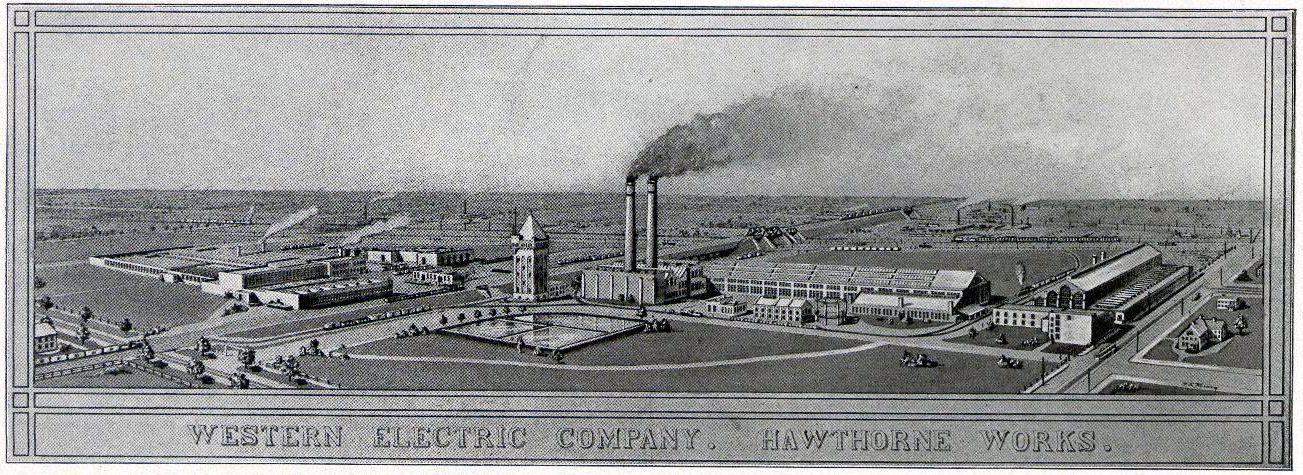
During the 1920s, a series of studies that marked a change in the direction of motivational and managerial theory was conducted by Elton Mayo on workers at the Hawthorne found of the Western Electric Visitor in Illinois. Previous studies, in particular Frederick Taylor'southward work, took a "man as machine" view and focused on ways of improving individual performance. Hawthorne, however, set the individual in a social context, arguing that employees' operation is influenced by piece of work surround and coworkers every bit much as by employee ability and skill. The Hawthorne studies are credited with focusing managerial strategy on the socio-psychological aspects of human behavior in organizations.
The following video from the AT&T archives contains interviews with individuals who participated in these studies. It provides insight into the manner the studies were conducted and how they changed employers' views on worker motivation.
The studies originally looked into the effects of physical weather on productivity and whether workers were more than responsive and worked more efficiently nether sure environmental atmospheric condition, such as improved lighting. The results were surprising: Mayo found that workers were more than responsive to social factors—such as their manager and coworkers—than the factors (lighting, etc.) the researchers set out to investigate. In fact, worker productivity improved when the lights were dimmed again and when everything had been returned to the style it was before the experiment began, productivity at the factory was at its highest level and absenteeism had plummeted.
What happened was Mayo discovered that workers were highly responsive to additional attention from their managers and the feeling that their managers actually cared most and were interested in their piece of work. The studies also found that although fiscal incentives are important drivers of worker productivity, social factors are equally important.
Practise Question
There were a number of other experiments conducted in the Hawthorne studies, including i in which two women were called every bit test subjects and were and so asked to cull 4 other workers to join the test group. Together, the women worked assembling telephone relays in a separate room over the class of 5 years (1927–1932). Their output was measured during this time—at first, in secret. It started ii weeks earlier moving the women to an experiment room and connected throughout the study. In the experiment room, they were assigned to a supervisor who discussed changes with them and, at times, used the women'due south suggestions. The researchers then spent 5 years measuring how different variables affected both the group's and the individuals' productivity. Some of the variables included giving two v-minute breaks (after a discussion with the grouping on the best length of fourth dimension), and then changing to 2 ten-minute breaks (not the preference of the grouping).
Irresolute a variable usually increased productivity, even if the variable was but a modify back to the original condition. Researchers concluded that the employees worked harder because they thought they were existence monitored individually. Researchers hypothesized that choosing one's ain coworkers, working as a group, being treated as special (as evidenced past working in a separate room), and having a sympathetic supervisor were the real reasons for the productivity increase.
The Hawthorne studies showed that people'southward piece of work performance is dependent on social bug and job satisfaction. The studies concluded that tangible motivators such equally budgetary incentives and practiced working atmospheric condition are by and large less of import in improving employee productivity than intangible motivators such as meeting individuals' desire to belong to a group and be included in conclusion making and work.
Practice Question
Demand-Based Theories
Maslow'south Bureaucracy of Needs
Homo motivation can exist defined every bit the fulfillment of various needs. These needs can encompass a range of human desires, from basic, tangible needs of survival to circuitous, emotional needs surrounding an individual's psychological well-being.
Abraham Maslow was a social psychologist who was interested in a broad spectrum of human psychological needs rather than on individual psychological problems. He is all-time known for his hierarchy-of-needs theory. Depicted in a pyramid (shown in Figure 1), the theory organizes the different levels of human psychological and concrete needs in society of importance.

Figure i. Maslow's bureaucracy of needs is illustrated here. In some versions of the pyramid, cognitive and aesthetic needs are also included betwixt esteem and self-actualization. Others include another tier at the acme of the pyramid for self-transcendence.
The needs in Maslow'due south hierarchy include physiological needs (nutrient and wearable), safety needs (job security), social needs (friendship), cocky-esteem, and self-actualization. This bureaucracy can be used by managers to meliorate understand employees' needs and motivation and address them in ways that lead to high productivity and job satisfaction.
At the lesser of the pyramid are the physiological (or basic) human being needs that are required for survival: nutrient, shelter, water, sleep, etc. If these requirements are not met, the trunk cannot go along to function. Faced with a lack of food, dear, and prophylactic, most people would probably consider food to be their nearly urgent demand.
One time physical needs are satisfied, security (sometimes referred to equally individual condom) takes precedence. Security and condom needs include personal security, financial security, and health and well-existence. These get-go two levels are of import to the physical survival of the person. In one case individuals have basic nutrition, shelter, and safety, they seek to fulfill higher-level needs.
The third level of need is social, which includes honey and belonging; when individuals have taken care of themselves physically, they can address their need to share and connect with others. Deficiencies at this level, on account of neglect, shunning, ostracism, etc., can bear on an private'due south ability to form and maintain emotionally significant relationships. Humans need to feel a sense of belonging and acceptance, whether it comes from a large social group or a modest network of family and friends. Other sources of social connection may be professional organizations, clubs, religious groups, social media sites, and and then forth. Humans demand to beloved and be loved (sexually and not-sexually) by others. Without these attachments, people can be vulnerable to psychological difficulties such equally loneliness, social anxiety, and depression. These weather condition, when severe, can impair a person'southward ability to address basic physiological needs such as eating and sleeping.
The fourth level is esteem, which represents the normal human desire to be valued and validated by others, through, for case, the recognition of success or condition. This level also includes self-esteem, which refers to the regard and acceptance i has for oneself. Imbalances at this level can event in depression cocky-esteem or an inferiority complex. People suffering from low cocky-esteem may find that external validation by others—through fame, celebrity, accolades, etc.—just partially or temporarily fulfills their needs at this level.
At the superlative of the pyramid is self-appearing. At this stage, people feel that they take reached their total potential and are doing everything they're capable of. Cocky-appearing is rarely a permanent feeling or state. Rather, it refers to the ongoing demand for personal growth and discovery that people accept throughout their lives. Self-actualization may occur later on reaching an important goal or overcoming a particular claiming, and it may be marked by a new sense of self-confidence or contentment.
Practise Question
Alderfer'south ERG Theory
 Clayton Paul Alderfer is an American psychologist who adult Maslow'south hierarchy of needs into a theory of his own. Alderfer's ERG theory suggests that at that place are iii groups of core needs: being (E), relatedness (R), and growth (G)—hence the acronym ERG. These groups align with Maslow's levels of physiological needs, social needs, and self-appearing needs, respectively.
Beingness needs concern our basic material requirements for living. These include what Maslow categorized as physiological needs (such as air, food, h2o, and shelter) and safety-related needs (such as health, secure employment, and property).
Relatedness needs have to do with the importance of maintaining interpersonal relationships. These needs are based in social interactions with others and marshal with Maslow's levels of love/belonging-related needs (such equally friendship, family, and sexual intimacy) and esteem-related needs (gaining the respect of others).
Finally, growth needs depict our intrinsic desire for personal development. These needs align with the other portion of Maslow's esteem-related needs (self-esteem, self-conviction, and achievement) and self-appearing needs (such as morality, creativity, problem-solving, and discovery).
Alderfer proposed that when a certain category of needs isn't being met, people will redouble their efforts to fulfill needs in a lower category. For instance, if someone'due south self-esteem is suffering, he or she volition invest more than effort in the relatedness category of needs.
Practice Question
McClelland's Acquired Needs Theory
 Psychologist David McClelland's acquired-needs theory splits the needs of employees into three categories rather than the two we discussed in Herzberg's theory. These three categories areachievement, affiliation, and power.
Employees who are strongly accomplishment-motivated are driven by the desire for mastery. They prefer working on tasks of moderate difficulty in which outcomes are the result of their effort rather than luck. They value receiving feedback on their work.
Employees who are strongly affiliation-motivated are driven by the desire to create and maintain social relationships. They relish belonging to a group and want to feel loved and accepted. They may not make constructive managers because they may worry too much about how others will feel well-nigh them.
Employees who are strongly power-motivated are driven past the want to influence, teach, or encourage others. They savor piece of work and identify a high value on discipline. Withal, they may take a zero-sum arroyo to grouping work—for i person to win, or succeed, another must lose, or neglect. If channeled accordingly, though, this arroyo can positively back up group goals and help others in the group feel competent.
The acquired-needs theory doesn't claim that people tin can be neatly categorized into one of three types. Rather, it asserts that all people are motivated by all of these needs in varying degrees and proportions. An individual's residual of these needs forms a kind of profile that can be useful in creating a tailored motivational paradigm for her. It is of import to note that needs do not necessarily correlate with competencies; information technology is possible for an employee to exist strongly affiliation-motivated, for example, but yet be successful in a situation in which her affiliation needs are not met.
McClelland proposes that those in top management positions mostly have a high demand for power and a low need for affiliation. He also believes that although individuals with a demand for achievement tin can make good managers, they are not mostly suited to being in summit management positions.
Do Question
McGregor'due south Theory X and Theory Y
The idea that a manager's attitude has an touch on employee motivation was originally proposed by Douglas McGregor, a management professor at the Massachusetts Plant of Engineering science during the 1950s and 1960s. In his 1960 volume, The Human Side of Enterprise, McGregor proposed two theories past which managers perceive and accost employee motivation. He referred to these opposing motivational methods as Theory X and Theory Y management. Each assumes that the manager's role is to organize resources, including people, to best benefit the company. However, beyond this commonality, the attitudes and assumptions they embody are quite dissimilar.
Theory X
According to McGregor, Theory X management assumes the following:
- Work is inherently distasteful to nearly people, and they will try to avoid work whenever possible.
- Near people are not aggressive, have little desire for responsibility, and prefer to exist directed.
- Most people accept piddling aptitude for creativity in solving organizational problems.
- Motivation occurs just at the physiological and security levels of Maslow's hierarchy of needs.
- Most people are self-centered. As a result, they must exist closely controlled and often coerced to achieve organizational objectives.
- Virtually people resist change.
- Most people are gullible and unintelligent.
 Essentially, Theory 10 assumes that the master source of employee motivation is monetary, with security as a stiff second. Under Theory X, one tin take a hard or soft approach to getting results.
The hard arroyo to motivation relies on coercion, implicit threats, micromanagement, and tight controls— essentially an surroundings of control and control. The soft approach, even so, is to be permissive and seek harmony in the hopes that, in return, employees volition cooperate when asked. All the same, neither of these extremes is optimal. The hard approach results in hostility, purposely depression output, and farthermost union demands. The soft arroyo results in a growing want for greater reward in exchange for macerated piece of work output.
Information technology might seem that the optimal approach to human resource management would lie somewhere between these extremes. However, McGregor asserts that neither arroyo is appropriate, since the basic assumptions of Theory Ten are incorrect.
Drawing on Maslow'due south bureaucracy of needs, McGregor argues that a demand, once satisfied, no longer motivates. The visitor uses monetary rewards and benefits to satisfy employees' lower-level needs. Once those needs have been satisfied, the motivation disappears. Theory X direction hinders the satisfaction of higher-level needs because information technology doesn't acknowledge that those needs are relevant in the workplace. As a outcome, the but fashion that employees tin can effort to meet higher-level needs at piece of work is to seek more compensation, so, predictably, they focus on monetary rewards. While coin may non be the most effective way to self-fulfillment, it may be the only way available. People will employ work to satisfy their lower needs and seek to satisfy their college needs during their leisure fourth dimension. However, employees tin can exist virtually productive when their work goals marshal with their higher-level needs.
McGregor makes the point that a command-and-command environment is not effective because it relies on lower needs for motivation, but in modern society those needs are mostly satisfied and thus are no longer motivating. In this situation, one would expect employees to dislike their work, avoid responsibility, have no involvement in organizational goals, resist change, etc.—creating, in consequence, a self-fulfilling prophecy. To McGregor, a steady supply of motivation seemed more likely to occur nether Theory Y management.
Theory Y
The higher-level needs of esteem and self-appearing are ongoing needs that, for about people, are never completely satisfied. As such, it is these higher-level needs through which employees tin all-time be motivated.
In strong contrast to Theory 10, Theory Y direction makes the following assumptions:
- Work can be as natural as play if the weather condition are favorable.
- People will be self-directed and creative to meet their work and organizational objectives if they are committed to them.
- People will be committed to their quality and productivity objectives if rewards are in place that address higher needs such every bit self-fulfillment.
- The capacity for inventiveness spreads throughout organizations.
- Most people tin can handle responsibleness because inventiveness and ingenuity are common in the population.
- Under these weather, people will seek responsibleness.
 Under these assumptions, there is an opportunity to marshal personal goals with organizational goals by using the employee'south own need for fulfillment every bit the motivator. McGregor stressed that Theory Y management does not imply a soft arroyo.
McGregor recognized that some people may not have reached the level of maturity assumed past Theory Y and may initially need tighter controls that tin can be relaxed equally the employee develops.
If Theory Y holds true, an organization can employ the following principles of scientific management to improve employee motivation:
- Decentralization and delegation: If firms decentralize control and reduce the number of levels of management, managers will have more subordinates and consequently demand to consul some responsibleness and decision making to them.
- Job enlargement: Broadening the scope of an employee's job adds variety and opportunities to satisfy ego needs.
- Participative management: Consulting employees in the decision-making process taps their creative chapters and provides them with some command over their piece of work environs.
- Performance appraisals: Having the employee set objectives and participate in the process of self-evaluation increases engagement and dedication.
If properly implemented, such an environment tin increase and continually fuel motivation equally employees piece of work to satisfy their college-level personal needs through their jobs.
Practice Question
Herzberg's Two-Factor Theory
American psychologist Frederick Herzberg is regarded as one of the corking original thinkers in management and motivational theory.Herzberg fix out to make up one's mind the effect of attitude on motivation, by only asking people to describe the times when they felt actually good, and really bad, well-nigh their jobs. What he found was that people who felt good about their jobs gave very dissimilar responses from the people who felt bad.
The results from this enquiry course the basis of Herzberg's Motivation-Hygiene Theory (sometimes known as Herzberg's "Two Factor Theory"). Published in his famous commodity, "1 More Fourth dimension: How exercise You Motivate Employees," the conclusions he drew were extraordinarily influential, and still class the bedrock of good motivational do nearly half a century afterwards. He's specially recognized for his 2-factor theory, which hypothesized that are two different sets of factors governing job satisfaction and job dissatisfaction: "hygiene factors," or extrinsic motivators and "motivation factors," or intrinsic motivators.
Hygiene factors, or extrinsic motivators, tend to represent more tangible, basic needs—i.e., the kinds of needs included in the existence category of needs in the ERG theory or in the lower levels of Maslow'due south hierarchy of needs. Extrinsic motivators include status, job security, salary, and fringe benefits. It's important for managers to realize that not providing the appropriate and expected extrinsic motivators will sow dissatisfaction and decrease motivation among employees.
Motivation factors, or intrinsic motivators, tend to stand for less tangible, more emotional needs—i.e., the kinds of needs identified in the "relatedness" and "growth" categories of needs in the ERG theory and in the higher levels of Maslow's hierarchy of needs. Intrinsic motivators include challenging work, recognition, relationships, and growth potential. Managers need to recognize that while these needs may fall exterior the more traditional scope of what a workplace ought to provide, they can be critical to strong individual and team performance.
The factor that differentiates two-cistron theory from the others we've discussed is the function of employee expectations. Co-ordinate to Herzberg, intrinsic motivators and extrinsic motivators have an changed relationship. That is, intrinsic motivators tend to increment motivation when they are present, while extrinsic motivators tend to reduce motivation when they are absent. This is due to employees' expectations. Extrinsic motivators (eastward.g., salary, benefits) are expected, so they won't increment motivation when they are in place, merely they volition cause dissatisfaction when they are missing. Intrinsic motivators (e.m., challenging work, growth potential), on the other hand, can be a source of additional motivation when they are available.

If direction wants to increase employees' job satisfaction, they should be concerned with the nature of the work itself—the opportunities it presents employees for gaining condition, assuming responsibility, and achieving self-realization. If, on the other manus, management wishes to reduce dissatisfaction, so it must focus on the task surround—policies, procedures, supervision, and working conditions. To ensure a satisfied and productive workforce, managers must pay attending to both sets of job factors.
Practice Question

Source: https://courses.lumenlearning.com/wmopen-organizationalbehavior/chapter/theories-of-motivation/
Posted by: meaghercasere1999.blogspot.com
0 Response to "How Might She Draw Upon And Apply The Theories Of Management And Motivation To Address These Issues?"
Post a Comment