

how to draw damian wayne robin head
| Robin | |
|---|---|
 Diverse incarnations of the character Robin, fine art by Yasmine Putri | |
| Publisher | DC Comics |
| Offset appearance | Detective Comics #38 (April 1940) |
| Created by | Bill Finger Bob Kane Jerry Robinson |
| Characters | Listing
|
| Robin | |
 | Cover of Robin (vol. 4) #1 (November 1993) featuring the Tim Drake version of the character, art past Tom Grummett and Scott Hanna |
| Serial publication information | |
| Publisher | DC Comics |
| Schedule | List
|
| Format | List
|
| Genre |
|
| Publication appointment | List
|
| Number of issues | List
|
| Master character(s) | List
|
| Artistic team | |
| Writer(s) | List
|
| Penciller(s) | Listing
|
| Inker(s) | Listing
|
| Colorist(s) | List
|
Robin is the allonym of several fictional superheroes actualization in American comic books published by DC Comics. The grapheme was originally created by Bob Kane, Bill Finger, and Jerry Robinson, to serve as a inferior analogue to the superhero Batman. The grapheme's beginning incarnation, Dick Grayson, debuted in Detective Comics #38 (April 1940). Conceived equally a way to attract young readership, Robin garnered overwhelmingly positive critical reception, doubling the sales of the Batman titles.[1] Robin'south early adventures included Star Spangled Comics #65–130 (1947–1952), the character's offset solo characteristic. He fabricated regular appearances in Batman-related comic books and other DC Comics publications from 1940 through the early 1980s, until the graphic symbol set up aside the Robin identity and became the independent superhero Nightwing. Every bit a squad, Batman and Robin have ordinarily been referred to as the Caped Crusaders and the Dynamic Duo.[2]
The character'south second incarnation, Jason Todd, offset appeared in Batman #357 (1983). He made regular appearances in Batman-related comic books until 1988, when he was murdered past the Joker in the storyline "A Death in the Family" (1989). Jason afterward institute himself live after a reality-changing incident, eventually becoming the Red Hood. The premiere Robin express serial was published in 1991, featuring the character'south third incarnation, Tim Drake, preparation to earn the role of Batman'due south vigilante partner. After two successful sequels, the monthly Robin serial began in 1993 and ended in early 2009, which also helped his transition from sidekick to a superhero in his own correct. In 2004 storylines, established DC Comics character Stephanie Brownish became the quaternary Robin for a short time before the function reverted to Tim Drake. Damian Wayne succeeds Drake as Robin in the 2009 story arc "Battle for the Cowl."
The electric current and old Robins always feature prominently in Batman's cast of supporting heroes; Dick, Jason, Tim, and Damian all regard him as a begetter. In current continuity as of 2022, Dick Grayson serves as Nightwing, Jason Todd is the Reddish Hood, Stephanie Brown is Batgirl, and Tim Drake has picked up the mantle of Robin again subsequently a stint as Red Robin. Damian has left behind the title Robin, but remains the title character of the Robin comic book. In recent years, Batman has as well adopted new sidekicks in the class of Bluebird, whose proper name references Robin, and The Betoken.
Cosmos
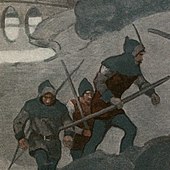
Characters from an illustration by N. C. Wyeth for "Robin Hood" (1917) past Paul Creswick. The await inspired Jerry Robinson's blueprint for Robin.[3] : 83
About a year later Batman's debut, Batman creators Bob Kane and Nib Finger introduced Robin the Boy Wonder in Detective Comics #38 (1940). The name "Robin the Male child Wonder" and the medieval look of the original costume were inspired past Robin Hood. Jerry Robinson noted he "came up with Robin because the adventures of Robin Hood were boyhood favorites of mine. I had been given a Robin Hood book illustrated past N. C. Wyeth ... and that's what I chop-chop sketched out when I suggested the proper name Robin Hood, which they seemed to similar, and then showed them the costume. And if yous await at information technology, it's Wyeth'due south costume, from my retention, considering I didn't have the volume to expect at."[3] : 83 Other accounts of Robin's origin state that the proper noun comes from the bird called the American robin, not from Robin Hood,[4] Frank Miller's All Star Batman and Robin existence a notable exception.[ peacock term ] [ commendation needed ] Sometimes both sources are credited, as in Len Wein's The Untold Legend of the Batman. Although Robin is best known every bit Batman's sidekick, the Robins have also been members of the superhero groups the Teen Titans (with the original Robin, Dick Grayson, every bit a founding member and the latter group'southward leader) and Young Justice.
In Batman stories, the character of Robin was intended to be Batman'due south Watson: Bill Finger, author for many early Batman adventures, wrote:[ citation needed ]
"Robin was an outgrowth of a conversation I had with Bob. Every bit I said, Batman was a combination of Douglas Fairbanks and Sherlock Holmes. Holmes had his Watson. The thing that bothered me was that Batman didn't take anyone to talk to, and it got a little irksome always having him thinking. I found that as I went along Batman needed a Watson to talk to. That'due south how Robin came to be. Bob chosen me over and said he was going to put a boy in the strip to identify with Batman. I thought it was a dandy thought."
Fictional graphic symbol biography
The following fictional characters have assumed the Robin role at diverse times in the main DC Comics Universe continuity:
Dick Grayson
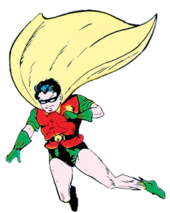
In the comics, Dick Grayson was an viii-twelvemonth-old acrobat and the youngest of a family human action chosen the "Flying Graysons". A gangster named Dominate Zucco, loosely based on role player Edward G. Robinson's Picayune Caesar graphic symbol, had been extorting money from the circus and killed Grayson's parents, John and Mary, past sabotaging their trapeze equipment equally a alarm against disobedience. Batman investigated the offense and, as his change ego billionaire Bruce Wayne, had Dick put nether his custody as a legal ward. Together they investigated Zucco and collected the evidence needed to bring him to justice. From his debut advent in 1940 through 1969, Robin was known every bit the Male child Wonder. Batman creates a costume for Dick, consisting of a red tunic, yellow greatcoat, green gloves, dark-green boots, dark-green spandex briefs, and a utility belt. Every bit he grew older, graduated from high school, and enrolled in Hudson University, Robin continued his career as the Teen Wonder, from 1970 into the early 1980s.
The character was rediscovered by a new generation of fans during the 1980s because of the success of The New Teen Titans, in which he left Batman's shadow entirely to assume the identity of Nightwing. He aids Batman throughout the later storyline regarding the several conflicts with Jason Todd until he makes his final return every bit the "Red Hood". Grayson temporarily took over every bit Batman (while Wayne was traveling through time), using the aid of Damian Wayne, making his newish appearance equally "Robin", to defeat and imprison Todd.[five] [half-dozen] With Bruce Wayne's return, Grayson went dorsum to existence Nightwing.
Jason Todd

DC was initially hesitant[ citation needed ] to turn Grayson into Nightwing and to replace him with a new Robin. To minimize the change, they made the new Robin, Jason Peter Todd, who showtime appeared in Batman #357 (1983), like to a immature Grayson. Like Dick Grayson, Jason Todd was the son of circus acrobats murdered by a criminal (this time the Batman adversary Killer Croc), and and so adopted by Bruce Wayne. In this incarnation, he was originally ruddy-haired and unfailingly cheerful, and wore his circus costume to fight crime until Dick Grayson presented him with a Robin conform of his ain. At that betoken, he dyed his hair black.
Afterwards the miniseries Crisis on Space Earths, much of the DC Comics continuity was redone. Dick Grayson'due south origin, years with Batman, and growth into Nightwing remained mostly unchanged; but Todd'southward character was completely revised. He was at present a black-haired street orphan who showtime encountered Batman when he attempted to steal tires from the Batmobile. Batman saw to it that he was placed in a school for troubled youths. Weeks later, after Dick Grayson became Nightwing and Todd proved his criminal offense-fighting worth past helping Batman catch a gang of robbers, Batman offered Todd the position every bit Robin.
Believing that readers never truly bonded with Todd, DC Comics made the controversial decision in 1988 to poll readers using a 1-900 number as to whether or not Todd should be killed. The event received more attending in the mainstream media than any other comic book effect before it. Readers voted "yep" by a small-scale margin (5,343 to 5,271) and Todd was subsequently murdered by the Joker in the storyline, A Death in the Family, in which the psychopath trounce the youngster severely with a crowbar, and left him to die in a warehouse rigged with a bomb.
Jason Todd later returned every bit the new Red Hood (the original allonym of the Joker) when he was brought back to life due to reality being altered. After the continuity changes following the New 52 DC Comics relaunch, Jason becomes a leader of the Outlaws, a superhero squad that includes Starfire and Arsenal who had spent years with Grayson in the Titans.
Tim Drake

DC Comics was left uncertain near readers' conclusion to take Jason Todd killed, wondering if readers preferred Batman equally a lone vigilante, disliked Todd specifically, or merely wanted to meet if DC would really kill off the character. In addition, the 1989 Batman film did not feature Robin, giving DC a reason to go along him out of the comic volume series for marketing purposes. Regardless, Batman editor Denny O'Neil introduced a new Robin. The third Robin, Timothy Drake, start appeared in a flashback in Batman #436 (1989) as a preadolescent boy, introduced by writer Marv Wolfman and interior penciler Pat Broderick. Drake'south starting time proper noun was a nod to Tim Burton, director of the 1989 Batman motion-picture show. The character beginning donned the Robin costume, and became associated with the third version of Robin, in the acclaimed "A Alone Identify of Dying" sequel storyline, which culminated in issue #442, written by Marv Wolfman with comprehend fine art by George Pérez and storyline interior pencils by Pérez, Tom Grummett, and Jim Aparo. In addition to establishing Tim Drake as a primary character in Batman and Detective Comics, Lauren R. O'Connor argues that "A Solitary Place of Dying" served as the dénouement of a transition from Dick Grayson's "absent sexuality," which before incited reader interpretations of homosexuality, to definitive heterosexual presence as a maturation narrative. O'Connor offers multiple examples from this 1989 storyline, such as Drake's encounter with Starfire and Grayson'south heeding of Drake'southward concerns over Batman's psychology, to substantiate the notion of a heterosexual bildungsroman subplot.[7]
The ensuing Tim Drake storylines, authored by Alan Grant and penciled by the late Norm Breyfogle, coupled with the 1989 release of Burton'due south Batman, spurred sales of both Batman and Detective Comics. For the latter title, Grant attested in 2007 that "when the Batman movie came out, the sales went upwards, if I recall correctly, from around 75,000 to about 675,000." 1989-90 was indeed the "Year of the Bat:" Capital and Diamond Metropolis Distributors reported that the Year One-inspired Batman: Legends of the Dark Knight dominated four out of the five spots for preorders (not total sales and second printings). The simply exception was the third preorder spot, snagged by Batman #442, the decision to Tim Drake's "A Lonely Place of Dying" storyline.[8] The "Twelvemonth of the Bat" continued into the first half of 1990. Preorders for Batman and Detective Comics issues featuring a revived Joker and Penguin began to compete with, and even edged out, the last three parts of Grant Morrison's and Klaus Janson's Gothic storyline in Legends. Todd McFarlane's Spider-Man arrived in the 2d half of 1990, inaugurating six months of Spidermania (or Mcfarlamania, depending on the reader).[9] DC closed out 1990 with vendors nether-ordering issues, prompting the publisher to push Batman #457 and the showtime role of the Robin mini-series into second and and so third printings. The side by side twelvemonth, 1991, witnessed the ascension of Chris Claremont's, Jim Lee'southward, and Scott Williams' Ten-Men against Magneto, likewise equally Fabian Nicieza'south and Rob Liefeld'southward 10-Strength, into the top of the preorder rankings. The only exception to this X-mania was, again, Tim Drake and the sequel to the Robin miniseries, the first variant upshot of which garnered the third spot, firmly wedged between variant issues of 10-Strength and X-Men. The mini-serial pitted solo Robin against the Joker, in response to fan demands for a matchup since "A Expiry in the Family." The 1990s comic booming bosom had begun.[10] In a supplemental interview with Daniel Best, Alan Grant added that "every issue from about that fourth dimension [afterwards the 'Year of the Bat'] that featured Robin sales went up because Robin did have his own fans." Although both Grant and Breyfogle initially believed that their Anarky graphic symbol could potentially become the 3rd version of Robin, they were quick to support the editorial decision to focus on Drake. The social anarchist duo adopted the character as their own in the early on 1990s, during Grant's shift to libertarian socialism simply before his late 1990s emphasis on Neo Tech. Breyfogle agreed that "it was a big thing to bring in the new Robin, yes. I know my fans ofttimes point specifically to that double page splash where his costume starting time appears as a big effect for them every bit fans and I unremarkably have to signal out to them that Neal Adams was the one who designed the costume. The 'R' symbol and the staff were all that was really mine." In the "Rite of Passage" storyline for Detective Comics, Grant and Breyfogle intertwined 1) Drake matching wits with Anarky; 2) a criminal and anthropological investigation into an apocryphal Haitian vodou cult (revealed by Batman, asserting anthropological and investigative dominance, as a forepart for extortion and crony capitalism); 3) the murder of Drake's mother by vilified cult leaders; 4) the beginning of Drake's recurrent nightmares and trauma; likewise as 5) the perspective of a child of one of the cult'south Haitian followers, unknowingly and inadvertently orphaned by Batman at the terminate of the 4-issue arc.[eleven]
Tim Drake eventually transitioned from belatedly preadolescence to adolescence, becoming the third Robin over the course of the storylines "Rite of Passage"[12] and "Identity Crunch,"[thirteen] with all problems scripted by Alan Grant and penciled by Norm Breyfogle. Story arcs that included Drake only in subplots or featured his training in criminal investigation, such as "Crimesmith"[14] and "The Penguin Matter,"[15] were either written or co-written by Grant and Wolfman, with pencils past Breyfogle, Aparo, and M. D. Bright. Immediately later, the character starred in the v-result miniseries Robin, [16] written by Chuck Dixon, with interior pencils past Tom Lyle and cover art by Brian Bolland. The new Batman and Robin team went on their commencement official mission together in the story "Debut,"[17] once more written past Grant and penciled by Breyfogle. Lauren R. O'Connor contends that, in early Tim Drake appearances, writers such as Grant and Chuck Dixon "had a lexicon of teenage behavior from which to depict, unlike when Dick Grayson was introduced and the concept of the teenager was still nascent. They wisely mobilized the expected adolescent behaviors of parental conflict, hormonal urges, and identity germination to give Tim emotional depth and complexity, making him a relatable character with boundaries between his two selves." In the Robin ongoing series, when Drake had fully transitioned into an boyish character, Chuck Dixon depicted him every bit engaging in adolescent intimacy, nevertheless withal stopped short at overt heterosexual consummation. This narrative criterion maintained Robin's "estrangement from sexual activity" that began in the Grayson years.[18] Erica McCrystal likewise observes that Alan Grant, prior to Dixon's serial, connected Drake to Batman'due south philosophy of heroic or anti-heroic "vigilantism" as "therapeutic for children of trauma. Just this kind of therapy has a delicate integration process." The overcoming of trauma entailed singled-out identity intersections and emotional restraint, too equally a "complete understanding" of symbol and cocky. Bruce Wayne, a former kid of trauma, guided "other trauma victims down a path of righteousness." Tim Drake, for example, endured trauma and "emotional duress" as a issue of the decease of his female parent (father in a coma and on a ventilator). Drake contemplated the thought of fearfulness, and overcoming it, in both the "Rite of Passage" and "Identity Crisis" storylines. Grant and Breyfogle subjected Drake to recurrent nightmares, from hauntings past a ghoulish Batman to the disquieting lullaby (or informal nursery rhyme), "My Mummy's dead...My Mummy'southward Expressionless...I tin can't get it through my caput," echoing across a cemetery for deceased parents. Drake ultimately defeated his ain preadolescent fears "somewhat distant from Bruce Wayne" and "not as an orphan." By the terminate of "Identity Crisis," an adolescent Drake had "proven himself every bit capable of beingness a vigilante" past discerning the function of fear in instigating a series of violent crimes.[nineteen]
In the comics, Tim Drake was a tardily preadolescent boy who had followed the adventures of Batman and Robin ever since witnessing the murder of the Flying Graysons. This served to connect Drake to Grayson, establishing a link that DC hoped would help readers have this new Robin. Drake surmised their underground identities with his apprentice but instinctive detective skills and followed their careers closely. Tim stated on numerous occasions that he wishes to become "The Globe'south Greatest Detective", a title currently belonging to the Dark Knight. Batman himself stated that one day Drake will surpass him every bit a detective. Despite his combat skills not being the lucifer of Grayson's (although at that place are some similarities, in that they are far superior to Todd's when he was Robin), his detective skills more than make up for this. In addition, Batman supplied him with a new armored costume for his transition to the adolescent Robin.[20]
Tim Drake's first Robin costume had a red trunk, yellowish stitching and belt, black boots, and light-green brusk sleeves, gloves, pants, and domino mask. He wore a cape that was black on the exterior and yellow on the inside. This costume had an armored tunic and gorget, an emergency "R" shuriken on his chest in addition to the traditional batarangs and a collapsible bo staff as his primary weapon, which Tim Drake continues to utilise as the superhero Red Robin. Neal Adams redesigned the entire costume with the exception of the "R" shuriken logo, starting time sketched by Norm Breyfogle.[21]
Tim Drake is the offset Robin to have his own comic volume series, where he fought crime on his own. Tim Drake, as Robin, co-founded the superhero team Immature Justice in the absence of the Teen Titans of Dick Grayson'south generation, only would then later re-form the Teen Titans after Immature Justice disbanded following a massive sidekick crossover during which Donna Troy was killed. Tim served as leader of this version of the Titans until 2009, at which point he quit due to the events of Batman R.I.P.
Post-obit Space Crunch and 52, Tim Drake modified his costume to favor a by and large red and blackness colour scheme in tribute to his best friend, Superboy (Kon-El), who died fighting Earth-Prime Superboy. This Robin costume had a red trunk, long sleeves, and pants. It likewise included blackness gloves and boots, yellow stitching and chugalug, and a blackness and yellow greatcoat. Tim Drake continued the motif of a red and black costume when he assumed the role of Red Robin earlier and during the events of The New 52.
Tim Drake assumes the identity of the Red Robin later on Batman's disappearance following the events of Final Crisis and "Battle for the Cowl" and Damian Wayne becoming Grayson's Robin. Following 2022's continuity changes resulting from The New 52 DC Comics relaunch, history was altered such that Tim Drake never took up the Robin mantle later on Jason Todd's expiry, feeling that it would be inappropriate. Instead, he served as Batman'south sidekick under the proper noun of the Cerise Robin. However, in DC's Rebirth relaunch, his original origin was restored.
Stephanie Brown
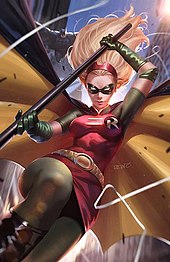
Stephanie Chocolate-brown on the encompass of Robin 80th Anniversary 100-Page Super Spectacular #1 (March 2022), art by Derrick Chew
Stephanie Brownish, Tim Drake'due south girlfriend and the costumed adventurer previously known as the Spoiler, volunteered for the role of Robin upon Tim's resignation. Batman fired the Girl Wonder for not obeying his orders to the letter on two occasions. Stephanie then stole 1 of Batman's incomplete plans to control Gotham's crime and executed information technology. Trying to prove her worthiness, Brown inadvertently set off a gang war on the streets of Gotham. While trying to help end the state of war, Brown was captured and tortured by the lunatic crime boss Black Mask. She managed to escape, but apparently died presently afterwards due to the severity of her injuries. Tim Drake keeps a memorial for her in his cave hideout underneath Titans Belfry in San Francisco. She appeared alive and stalking Tim, after his return from traveling around the earth with his mentor.[22] It turned out that Dr. Leslie Thompkins had faked Stephanie'south death in an try to protect her.[23] For years she operated on and off every bit the Spoiler, simply was then recruited every bit Barbara Gordon'south replacement as Batgirl. She had her own series, as well as making appearances throughout various Batman and Batman spin-off series. Her fourth dimension every bit the Spoiler, Robin, and Batgirl was retconned to take never occurred afterwards the Flashpoint event, with her being reintroduced having just get the Spoiler in Batman Eternal. Nevertheless, her history as Robin was later restored.[24]
Damian Wayne

Damian Wayne on the encompass of Robin: Son of Batman (vol. one) #8 (January 2022), art past Patrick Gleason
Damian Wayne was the child of Bruce Wayne and Talia al Ghul, thus the grandson of the immortal Ra's al Ghul. Batman was unaware of his son'south existence for years until Talia left Damian in his intendance. Damian was violent and lacking in discipline and morality, and was trained by the League of Assassins. Learning to kill at a immature age, Damian's murderous behavior created a troubled relationship with his male parent, who vowed never to take a life.
Originally conceived to get a host for his maternal granddaddy'southward soul every bit well every bit a pawn confronting the Nighttime Knight, Batman saved his child from this fate, which forced Ra's to inhabit his own son's body, and thus, Damian was affectionate to his father. Later on Batman's apparent death during Final Crisis, Talia left her son nether Dick Grayson and Alfred Pennyworth's care and Damian was deeply affected by his male parent's absence. In the starting time issue of "Battle for the Cowl", Damian was driving the Batmobile and was attacked by Poison Ivy and Killer Croc. Damian was rescued past Nightwing, who then tries to escape, but was shot downwards by Black Mask's men. Nightwing tried to fight the thugs, but the thugs were shot by Jason Todd. After a fight between Nightwing and Todd, Todd eventually shot Damian in the chest. In the final result of the series, Alfred fabricated Damian into Robin. Damian'due south get-go chore as Robin was to rescue Tim. After "Battle for the Cowl", Grayson adopted the pall of Batman, and instead of having Tim (who he viewed as an equal rather than a protégé) remain as Robin, he gave the role to Damian, who he felt needed the training that his male parent would have given him.
Following the Batman: The Render of Bruce Wayne and Flashpoint events, Bruce Wayne returned to his role as Batman, while Dick resumed every bit Nightwing. Equally of The New 52, Damian continued to work with his begetter, only temporarily gave upward existence Robin (as his mother had put a toll on his caput), and went under the identity of Red Bird. Damian met his end at the easily of the Heretic, an aged clone of Damian working for Leviathan, bravely giving up his life.[25] Despite his status as deceased, Damian starred in his own miniseries, Damian: Son of Batman, written and drawn past Andy Kubert, set in a future where Damian is on the path to go Batman afterward his father savage victim to a trap set up by the Joker. Batman eventually started a difficult quest to resurrect him, returning Damian to life with Darkseid'southward Chaos Shard.[26]
Other versions
Bruce Wayne
A Batman story from the 1950s featured the immature Bruce Wayne bold the identity of Robin, complete with the original costume, in club to learn the nuts of detective work from a famous detective named Harvey Harris. The purpose of the cloak-and-dagger identity was to prevent Harris from learning Wayne's true motivation for approaching him, which could accept led to the detective attempting to discourage the boy from pursuing his obsession.[27] Though this story remained canonical through most of the 1980s (information technology was revisited in the 3-issue miniseries The Untold Legend of the Batman in 1980), it was revised Mail service-Crisis to edit out whatsoever reference to Bruce Wayne having ever called himself "Robin" or worn whatsoever costume before he finally donned his Batman costume as an adult.[28] John Byrne later worked this aspect into his non-approved story Superman & Batman: Generations.
Post-Crisis, there was one example in continuity when Bruce Wayne adopted the Robin persona. In Batboy & Robin, a tie-in special to the DC Comics storyline Sins of Youth, Bruce and Tim Drake, the third Robin, had their ages magically switched. In an effort to keep up the illusion of Batman, Bruce had Tim adopt the Batman identity, while he is forced to be Robin.
Earth-Ii Robin, earlier Crisis on Infinite Earths

The Pre-Crisis Earth-Two Robin
On Earth-Two, dwelling of the Golden Age version of DC's superheroes, Dick Grayson continued to be Robin even every bit an adult, having no successors, and fifty-fifty after Batman's decease. His allies as a boy included the All-Star Squadron, forth with Batwoman and Flamebird.
By the 1960s, Grayson had become an adult, and was a lawyer and the ambassador to South Africa. He adopted a more Batman-like costume, but nonetheless fought crime as Robin. This developed version of Dick Grayson debuted in Justice League of America #55, where he likewise became a member of the Justice Society of America. Although in semi-retirement for a time, he was chosen back to active duty when he rejoined the Justice Club during the menses when he, Power Girl and the Star-Spangled Kid, assisted them as the Super Squad.
He appeared to accept died during the 1985 miniseries Crisis on Space Earths, in which the DC Multiverse was reduced to one Universe, and this version of Grayson, too as the Earth-Two Batman, were deemed never to have existed. The Earth-2 concept was revived and reimagined twice afterwards, following the comic books 52 (2006–7) and Flashpoint (2011).
The Toy Wonder
In the DC Ane Meg storyline, members of the Justice League of America encounter a variety of heroes from the future, including an 853rd-century Batman who patrols the prison planet Pluto. This version of Batman is accompanied by a robotic Robin who contains a transcribed copy of his own personality from before his parents were murdered by Plutonian criminals.
This Robin (who calls himself "the Toy Wonder") is a fellow member of the Justice Legion T in addition to serving as a deliberate counterbalance to Batman's dark personality.
Elseworlds versions
Elseworlds versions of DC characters are ones that exist in alternate timelines or realities that take place in entirely self-independent continuities. In Elseworlds, Robin has been a German language immigrant during World State of war II named Richart Graustark, Bruce Wayne Jr. (the son of Julia Madison and Bruce Wayne), a genetically enhanced ape named Rodney, a samurai named Tengu, a pirate's cabin boy, a girl traveling via space transport to a far-off colonial planet, Bruce Wayne's nephew Thomas Wayne Iii, MI-half-dozen agent Alfred Pennyworth, Bruce Wayne'southward sister during the Reign of Terror in France, and a Native American named Blood-red Bird.
Carrie Kelley
In Frank Miller'south non-canonical The Nighttime Knight Returns, the function of Robin is filled past Carrie Kelley, a 13-year-old girl. She becomes Robin, and is accepted by the Batman after she saves his life. Unlike the previous Robins, Carrie is not an orphan, only she appears to have rather neglectful parents who are never actually depicted (i of them mutters "Didn't we have a kid?" while their daughter is watching the tearing battle betwixt Batman and the Mutants). It is hinted through their dialogue that they were one time activists and perchance hippies during the 1960s, but have since become apathetic stoners. She was the outset female Robin and the first Robin with living parents. In the sequel, Batman: The Nighttime Knight Strikes Again, 2001, Carrie dons the identity of Catgirl, but withal works as Batman'south second-in-command.
She was also featured in an episode of The New Batman Adventures entitled "Legends of the Night Knight". She then appeared in Batman: The Dauntless and the Bold 's episode entitled "Batman Dies At Dawn!" along with Dick Grayson, Jason Todd, Tim Drake, Stephanie Brown, and Damian Wayne. Kelley joined the New 52 DC universe in Batman and Robin #nineteen, in a story titled Batman and Red Robin.[29]
Talon
The Law-breaking Syndicate version of Robin is called Talon on Earth-3, associate of Owlman. Talon refers to Owlman as his male parent; whether he is the biological son of Thomas Wayne II or an alternating version of Jason Todd or Tim Drake is unknown. Talon first appeared in Teen Titans #32 (March 2006).[30]
52 Multiverse
In the concluding upshot of 52, a new Multiverse is revealed, originally consisting of 52 identical realities. Amidst the parallel realities shown is one designated "World-2". As a outcome of Mister Listen "eating" aspects of this reality, it takes on visual aspects similar to the Pre-Crunch Earth-two, including Robin, among other Justice Society of America characters.[31] Based on comments past Grant Morrison, this alternate universe is not the pre-Crisis Earth-ii.[32] However, in Justice Society of America Annual #1, published in 2008, the Silver Scarab explains that the events of the Crisis are remembered by the people of this Earth-two, and from their perspective, Earth-2 seemed to exist the only Globe to accept survived the Crunch, raising theories equally to whether or not Earth-2 was really destroyed, or was perhaps replaced past a new Earth-2. Indeed, in Justice Guild of America #20, published in December 2008, Starman explains that during the re-expansion of the DC Multiverse, Earth-2 was reborn "along with everyone on information technology", including Robin.
Following Flashpoint (2011) and The New 52 reboot, this Earth is replaced by another reimagining of Earth 2, one where Batman's daughter Helena Wayne served as Robin until an incident five years prior to the relaunch sent her to DC's master continuity, Globe-0, where she works as the Huntress. The 2022 series Earth 2: Earth's End establishes that Dick Grayson never served as Robin on this Earth, and was instead a reporter who married Barbara Gordon and had a son. During Darkseid'due south invasion of Globe 2, Barbara is killed, and Dick is trained in how to fight by Ted Grant and goes on a mission to find his missing son.
Robin monthlies
The kickoff Robin miniseries was printed in 1992 following Tim Drake'southward debut as Robin. The series centered around Tim'due south continued grooming and set up villains linked to the character. Information technology was followed up by some other series Robin Two: The Joker'due south Wild!, which pitted Tim confronting his predecessor's murderer the Joker. With Batman out of town, information technology was up to Tim and Alfred to cease the Joker's latest crime spree. A final miniseries, Robin Iii: Cry of the Huntress wrapped up the trilogy, teaming Tim with the Huntress. In 1993, the success of the three miniseries led to the ongoing Robin series, which ran 183 issues until 2009. The title was replaced by a Batman and Robin series post-obit the Battle for the Cowl miniseries, as well as an ongoing Red Robin monthly which continues the story of Tim Drake.
The ongoing Robin serial has taken function in a number of crossovers with other comics, especially Batman and related serial. These include:
- Robin (vol. iv) #7: Knightquest: The Search
- Robin (vol. 4) #8: KnightsEnd
- Robin (vol. iv) #9: KnightsEnd: Aftermath
- Robin (vol. iv) #11–xiii: Prodigal
- Robin (vol. 4) #xiv: Troika
- Robin (vol. 4) #27–28: Batman: Contamination
- Robin (vol. four) #32–33: Batman: Legacy
- Robin (vol. 4) #52–53: Batman: Cataclysm
- Robin (vol. iv) #67–73: Batman: No Homo'due south Land
- Robin (vol. 4) #86: Batman: Officer Down
- Robin (vol. 4) #95: Joker: Last Laugh
- Robin (vol. four) #98–99: Bruce Wayne: Murderer?
- Robin (vol. iv) #129–131: Batman: War Games
- Robin (vol. 4) #168–169: The Resurrection of Ra's al Ghul
- Robin (vol. 4) #175–176: Batman R.I.P.
In improver, two Robin-related series launched in June 2022: We Are Robin, featuring writer Lee Bermejo and artists Rob Haynes and Khary Randolph, and detailing multiple teenagers in Gotham who take upward the mantle of Robin; and Robin, Son of Batman, written and drawn by Patrick Gleason, showing the individual adventures of Damian Wayne.
Reception
Co-ordinate to Entertainment Weekly in 2008, Robin is one of the "greatest sidekicks".[33]
Portrayals
Robin (Dick Grayson) was portrayed past Douglas Croft and Johnny Duncan, respectively, in the 1943 and 1949 15 affiliate Batman serials. Burt Ward played him in the 1966–1968 Batman goggle box series and the related 1966 moving-picture show. In the live-activeness movies Batman Forever and Batman & Robin, he was played by Chris O'Donnell. Michael Cera voiced the character in The Lego Batman Movie.
The Dick Grayson version of Robin also appears in Batman: The Blithe Series, voiced past Loren Lester. Grayson is replaced by Tim Drake, played by Mathew Valencia, in the subsequent series The New Batman Adventures.
An older version of Robin (Dick Grayson) is portrayed past Brenton Thwaites in the live action serial Titans.
The animated series Teen Titans features Robin (voiced by Scott Menville) every bit the leader of a team of young heroes; information technology is hinted in several episodes that this Robin is Dick Grayson. In the season two episode "Fractured", a version of Bat-Mite is introduced who claims to be Robin'south "DNA buddy" (genetic twin). Bat-Mite gives his proper noun as Nosyarg Kcid ("Dick Grayson" spelled backwards). In another episode, Raven reads Robin'due south heed and sees a man and a adult female falling from a trapeze (an event known just to have happened to Grayson and non to whatever other Robin). In another episode, Starfire travels to the future and discovers that Robin has taken the identity of Nightwing. Menville reprises his role as Robin in Teen Titans Go!. The 2nd-season episode "The Best Robin" introduces Carrie Kelly and Tim Drake equally their Robins. They are also voiced by Menville.
Robin is also seen in the 1987 Zeller'southward commercial, which features the infamous catchphrase, "Well said, Robin!".
Dick Grayson is Robin in Young Justice, voiced by Jesse McCartney. In the second flavor, Grayson has go Nightwing, while Tim Drake, voiced by Cameron Bowen, is the new Robin, succeeding Jason Todd, who is already dead past the start of the flavour.
Robin is portrayed by Nick Lang in Holy Musical B@homo!. His portrayal is based mainly on Burt Ward's Dick Grayson.
Nerveless editions
| Title | Material collected | Pages | Publication engagement | ISBN |
|---|---|---|---|---|
| Robin Vol. one: Reborn | Batman #455–457; Detective Comics #618–621; Robin #1–five | 296 | Nov x, 2022 | Paperback: 978-1401258573 |
| Robin Vol. two: Triumphant | Batman #465, 467–469; Robin Ii: The Joker's Wild! #1–4; Robin Three: Cry of the Huntress #1–6 | 360 | March 22, 2022 | Paperback: 978-1401260897 |
| Robin Vol. 3: Solo | Robin (vol. iv) #1–v; Robin Almanac #1–two; Showcase '93 #5–6, 11–12 | 328 | December 6, 2022 | Paperback: 978-1401263621 |
| Robin Vol. iv: Turning Indicate | Robin (vol. iv) #6–13; Showcase '94 #5–6 | 264 | July 25, 2022 | Paperback: 978-1401265878 |
| Robin Vol. 5: State of war of the Dragons | Robin (vol. iv) #14–22; Robin Annual #3; Detective Comics #685–686 | 328 | January 2, 2022 | Paperback: 978-1401275129 |
| Robin: Son of Batman Vol. 1: Year of Blood | Robin: Son of Batman #i–half dozen | 176 | March 29, 2022 | Hardcover: 978-1401261559 Paperback: 978-1401264796 |
See likewise
- Homosexuality in the Batman franchise
- List of exclamations by Robin
References
- ^ Daniels, Les (2004). Batman: The Complete History. Relate Books. p. 37. ISBN0-8118-4232-0.
- ^ Fleisher, Michael L. (1976). The Encyclopedia of Comic Book Heroes, Volume one: Batman. Macmillan Publishing Co. pp. 317–332. ISBN0-02-538700-six . Retrieved 29 March 2022.
- ^ a b Groth, Gary (November 2005). "Jerry Robinson: Been There, Done That". The Comics Journal #271
- ^ Bridwell, Eastward. Nelson (w), Andru, Ross (p), Esposito, Mike (i). "The Origin of Robin" Batman #213 (July–Baronial 1969), DC Comics
- ^ Phillips, Dan (May 22, 2009). "Grant Morrison'south New Batman and Robin". IGN . Retrieved December xv, 2022.
- ^ George, Richard (March 11, 2009). "Grant Morrison Discusses Batman and Robin". IGN . Retrieved Dec 15, 2022.
- ^ O'Connor, Lauren R. (2021). Robin and the Making of American Adolescence. New Brunswick: Rutgers University Press. pp. 50–54. ISBN9781978819795.
- ^ "Comichron: 1989 Comic Volume Sales to Comics Shops". www.comichron.com.
- ^ "Comichron: 1990 Comic Book Sales to Comics Shops". www.comichron.com.
- ^ "Comichron: 1991 Comic Volume Sales to Comics Shops". www.comichron.com.
- ^ Irving, Christopher (June 2007). "Gotham City's Other Dynamic Duo". Dorsum Effect. 1 (22): 18–20 (with Daniel Best interview notes).
- ^ Detective Comics #618-621, July-Sept. 1990
- ^ Batman #455-457, Oct.-Dec. 1990
- ^ Batman #443-444, Jan.-Feb. 1990
- ^ Detective Comics #615 and "Batman" #448-49, June 1990
- ^ Robin #1-5, Jan.-May 1991
- ^ Batman #465
- ^ O'Connor, Lauren R. (2021). Robin and the Making of American Boyhood. New Brunswick: Rutgers University Press. p. 54. ISBN9781978819795.
- ^ McCrystal, Erica (2021). Gotham Urban center Living: The Social Dynamics in the Batman Comics and Media. London, UK: Bloomsbury Academic. pp. 36–46. ISBN9781350148895.
- ^ Greenberger, Robert (2008). The Essential Batman Encyclopedia. Del Rey. pp. 119–122. ISBN9780345501066.
- ^ Sawyer, James. "Robin Relics: Designing Tim Drake'southward Robin Costume..."
- ^ Robin (vol. 4) #172
- ^ Robin (vol. 4) #174
- ^ Immature Justice (vol. three) #5
- ^ Batman Incorporated #eight
- ^ Batman and Robin (vol. two) #37 (December 2022)
- ^ Edmond Hamilton (w), Dick Sprang (p), Charles Paris (i). ""When Batman Was Robin"" Detective Comics #226 (December 1955), DC Comics
- ^ Mark Waid, Brian Augustyn (w), Val Semeiks (p), Michael Bair (i). ""Blood Secrets"" Detective Comics Almanac #2 (1989), DC Comics
- ^ Esposito, Joey (Apr 5, 2022). "The Dark Knight Returns' Carrie Kelley is Back". Retrieved April half dozen, 2022.
- ^ Teen Titans Vol 3 #38
- ^ 52 52: thirteen/three (May 2, 2007), DC Comics
- ^ Brady, Matt (May viii, 2007). "The 52 Exit Interviews: Grant Morrison". Newsarama. Archived from the original on May 10, 2007. Retrieved May 12, 2007.
- ^ Schott, Ben (March 21, 2008). "Schott's Miscellany Calendar 2009". Entertainment Weekly. New York: Workman Publishing.
External links
- Robin at DC Comics' official website
- Robin on IMDb
- Extensive biography on Dick Grayson
- Extensive biography on Jason Todd
- All-encompassing biography on Tim Drake
- Robin on DC Database, a DC Comics wiki

Source: https://en.wikipedia.org/wiki/Robin_%28character%29
Posted by: meaghercasere1999.blogspot.com
0 Response to "how to draw damian wayne robin head"
Post a Comment